
After a brutal selloff since October, foreign portfolio investor (FPI) flows for the year-to-date (YTD) in 2024 have turned negative. In early September, YTD FPI investments peaked at a record Rs 22,000 crore ($2.6 billion). This wave of selling has also pulled down benchmark indices, with the Nifty's YTD returns declining to 11 per cent from their high of 21 per cent in September.


Analysts are warning of growing risks to the market's sustained momentum, and even to the possibility of consolidation at current levels. Domestically, markets are grappling with several challenges, including a slowing economy, as indicated by the latest GDP data for the July-September (Q2) quarter of 2024-25 (FY25), sticky inflation, fluctuations in the rupee, waning consumption, and high interest rates.
Financial subsidies that are not WTO-compatible will have to be phased out and GSP benefits will not be available for long. Things have just got tougher.
Commerce and Industry Minister Kamal Nath said on Saturday that India now must gear up for agricultural exports apart from export of manufactured goods and services.
India has set a target of $160 billion for merchandise exports during 2007-08.

Quarterly earnings of corporates, trading activity of foreign investors and inflation data are the key factors that are expected to drive the momentum in the equity markets this week, analysts said.

Shigeru Ishiba is expected to prioritise strengthening Japan's military capabilities and fostering deeper international partnerships, particularly with India, with whom Japan shares significant strategic interests, explains Dr Rajaram Panda.
The commerce ministry is currently firming up the annual supplement to the FTP, which is likely to be unveiled in April. Referring to the export performance during 2007-08, Commerce Minister Kamal Nath said, actual export was likely to remain short of the target of $160 billion. The exports during the year were likely to reach a level of $152-155 billion, he added.

Exports to Greece from India are $360 million a year.

Cheaper ripoffs was how China powered its way as an economic superpower but hitherto the tech realm had remained out of bounds. With DeepSeek's AI model the West, it seemed, was about to lose its competitive edge in cutting edge generative AI technology. And this is what is causing deep furrows in the forehead of tech titans in Silicon Valley.
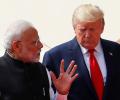
'While criticising India's high tariffs, Mr Trump stated he would impose reciprocal taxes on Indian products if re-elected.' 'However, since India's tariffs follow WTO rules, Mr Trump's actions would violate these rules,' Ajay Srivastava points out.

'It was the hostility of the Yunus regime that made India careful and wary of dealing with them.' 'They gradually backed off and lowered the noise, but the damage was done.' 'Their true colours had been exposed.'
The change in the Foreign Trade Policy means that jet fuel sold in India to international flights will be treated as physical exports and not attract most of the domestic tariffs.
India's exports on Friday crossed the $100 billion mark to reach $101 billion in 2005-06

From the 30 Sensex pack, State Bank of India, Mahindra & Mahindra, Bharti Airtel, Titan, HDFC Bank, IndusInd Bank, Axis Bank and Bajaj Finance were the biggest laggards. JSW Steel, Tech Mahindra, Larsen & Toubro, Hindustan Unilever, HCL Technologies and Reliance Industries were among the gainers from the pack.

From early indications, the Modi government's foreign policy seems to be pragmatic and reciprocal, says K G Suresh.

The outcome of the Union Budget, quarterly earnings from corporates and global trends are the major factors to drive stock market sentiments this week, analysts said. Besides, the trading activity of foreign investors, the rupee-dollar trend and the movement of global oil benchmark Brent crude are also crucial aspects to watch out for.

Once we break free of the idea that land is scarce, real estate is just a pile of bricks, steel, and glass. Any price surge will kick off a supply response, which kills off the possibility of sustained price appreciation, points out Ajay Shah.

RBI interest rate decision, macroeconomic data and global trends would guide markets' movement this week, analysts said. Besides, trading activity of foreign investors and the last batch of Q1 earnings announcements would also guide trends in equities. HSBC PMI (Purchasing Managers' Index) for the services sector is scheduled to be announced on Monday.

Their favourite alternatives: Malaysia, Vietnam and the Philippines. Note, India is missing from that list. And this is despite an attractive financial incentive scheme for OSAT players. The reason, said a senior executive of a US chip company who had a meeting in Taiwan just a few weeks ago, is that "they want more predictability in government policy because they plan to put in big money."
India's foreign exchange reserves have jumped to an all-time high of $651.5 billion as of May 31, Reserve Bank Governor Shaktikanta Das said on Friday. This means the overall kitty has increased by $4.83 billion since the last reported number of $646.673 billion on May 24 this year.

Assam Chief Minister Himanta Biswa Sarma has accused Congress MP Gaurav Gogoi of raising questions on sensitive defence matters in Parliament after his marriage to a British citizen. Sarma alleged that Gogoi's wife, Elizabeth Colburn, has links with the Pakistani establishment, including working for an organisation allegedly a front for the Inter-Services Intelligence (ISI). Gogoi has rejected the allegations as "baseless" and said the BJP is trying to divert attention from its own failures.

The impact of Trump's announcement of increasing import tariffs will have negligible benefit for India not because of companies trying to shift from China to other countries or their supply chains being affected due to their Chinese operations but because of our faulty policies, explains Mudit Jain.

The US Federal Reserve's interest rate decision is the biggest event that would drive sentiments in the domestic stock market this week, besides a host of macroeconomic data from the global front and trading activity of foreign investors, analysts said. The Indian equity market had an exceptional last week, with both the Nifty and Sensex hitting their all-time high levels on Thursday.

Another priority in the first 100 days could be the launch of an e-platform -- Trade Connect -- to help exporters connect with stakeholders of international trade.

Gold, a safe-haven bet, is likely to continue its record-smashing journey in the New Year, rising to Rs 85,000 per 10 grams and even Rs 90,000 level in domestic markets if geopolitical tensions and global economic uncertainties continue.
Buoyed by the momentum created in the last fiscal, India's export target for 2005-06 has been revised upwards to $92 billion from $88 billion, Union Minister of State for Commerce E V K S Elangovan said on Monday.

As Donald Trump registered a historic comeback in the US presidential election, many former Indian diplomats on Wednesday concurred that the India-US ties will "continue to grow" from strength to strength, even as some of them cautioned that Trump is "highly unpredictable" and New Delhi will have to "wait and watch" to see what position he adopts going forward.

'Shark fins are the most sought-after shark product.'

The index could be vulnerable to a bigger fall given the present market dynamics.
